Intuitive Beats

Tutorials

Ableton Tutorial – Rhythmic Gated Patterns

posted by DJ Story on Apr.25, 2011, under Ableton Live

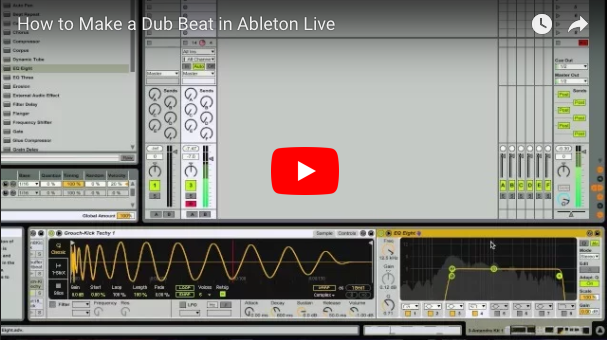
In this tutorial I share a technique for turning any texture, pad, or soundscape into a tight rhythmic stuttering pattern. It’s accomplished using sidechain options of the gate effect in Ableton Live. This type of effect is something you hear in a lot of psy dub, psy trance, and psybient music. You hear it used in many songs by artists like Shpongle, Ott, Bluetech, Phutureprimitive, and many more.

1 Comment :, , , , , , , , , , , more...

The Relationship Between Keys & Chord Forms

posted by DJ Story on Apr.21, 2011, under Music Theory

In my last article, Guitar Chord Theory – Hang-in There Its a Long Story we looked at scales and the order of steps and half-steps that are used to make a scale. If you haven’t read it you probably should as it will make this article much easier to follow. It’s important to remember that different scales have a different number of sharps or flats in them.

A key for our purpose is a bunch of related chords that sound good together. If you already play guitar you may have noticed that a song that starts with a C chords is very likely to have F & G chords with it and maybe an Am chord also. This tells us that the song is in the key of C, not so much because the song starts on C but because if the relationship of the chords, if the song started on the F chord it is still in the Key of C. another example would be a song with G C D and maybe Em, this song would be in the key of G because of the relationship of the chords.

Let’s use the C Major scale as it suits the purpose best.

C Major Scale: C D E F G A B C

Scale Degrees: 1 2 3 4 5 6 7 8

Roman Numerals: I II III IV V VI VII VIII

All major chords are made up of the 1st, 3rd and 5th degrees of a scale. This would give us in the Key of C: C E G This is known as a tonic triad. The C is the root note of the scale and chord. It is also the tonic note. C E G is a C major tonic triad. ‘Tonic’ since it has the C as the first note and ‘triad’ since it has three (tri) notes in it.

When we talk of chords built on the different degrees of a scale we use Roman numerals.

The most important and best sounding chords that blend in with the C Major scale are chords that are built on the IV & V degrees of that scale. This gives us chords built on F(IV) and G(V).

A chord/tonic triad built on the IV i.e. F would be F A C (F A C being the 1st, 3rd and 5th degrees of an F scale) the chord/tonic triad would be an F Major chord.A chord/tonic triad built on the V i.e. G would be G B D (G B D being the 1st, 3rd and 5th degrees of the G scale) the chord/tonic triad would be a G Major chord.

The reason these two chords are so suited to C is that they both have notes in common with the C Major chord. F(IV) has the note C in common and G(V) has the G note in common. These common notes make the changes between the chords easy on the ear. Both the IV and V are major chords.

The next most likely chord to be used is one that is built on the VI degree i.e. A and the 1st 3rd 5th of the A scale is A C# E, well we shouldn’t have a C# in a in it as there is not a C# in the C scale. The C# must become a C and would then be A C E and this is an A minor chord. So in any key, a chord built on the VI of the scale needs to be a minor chord. This follows with all chords built on the notes of a scale, they must conform to the C scale.

All chords we wish to play in a key should be built on the notes of that scale. This applies to any key we play in i.e. in the key of A we use only the notes of the A scale. In the key of G only the notes of the G scale.

Below is a chart with the C major scale and the different chords that can be built on each degree of the scale, the note found in each chord, and the type of chord.

All other Keys have the same association of chords i.e. the II, III & VI should always be a minors. The VII will always be a minor b5.

It isn’t essential that this method be used and many songs have been written using whatever chords the writer likes.

It does however give us the theory behind compatible chords that can be used as additional or passing chords within a song.

Chords built on the scale degrees

Scale Degree Tonic Triad Chord Type

C I C E G C (Major)

D II D F A Dm (Minor)

E III E G B Em (Minor)

F IV F A C F (Major)

G V G B D G (Major)

A VI A C E Am (Minor)

B VII B D F Bmb5 (Minor b5)

C VIII C E G C (Major)
www.nofretguitarlessons.com.au

1986 Diploma in Music – Classical Guitar Major. I have been performing professionally for 34 years either as solo instrumentalist, in duos, trios and in rock bands playing guitar or bass guitar. 10 years ago I started teaching guitar, bass and music theory which led me to independently writing, producing and publishing The Guitar Instruction, Musicianship & Reference Manual with DVD on Left & Right Hand Techniques.
www.nofretguitarlessons.com.au

Source: http://www.articletrader.com

2 Comments :, , , , , , , , , , more...

How To Make Your Own Hip Hop Beats In 5 Simple Steps

posted by DJ Story on Apr.21, 2011, under Hip Hop

by Kim M. Rush

Beat maker software has been one of the many successes in the modern technology. Why? Because it has answered the call of many music lovers who wants to create their own music on a computer. Before, it was really hard to produce your own music. You can’t even do it yourself without proper training. And these machines are huge with complicated controls. So when the software was created, everyone was full of joy. To make your own hit hop beats is very easy. It only involves 5 steps to complete a high quality music. Here are the steps to guide you: 1. First thing you should do is to select a reliable hip hop beat maker software. To determine which among the many brands is the best, check on reviews and forums People participating in these sites will tell you their real experience with the software they’ve purchased. And when we talk about reliable software, the best example is Sonic Producer. This software has gained good feedback from many users as they have proven its quality when it comes to music production. Read more: How To Make Your Own Hip Hop Beats In 5 Simple Steps | Free Niche Business Articles For Internet Marketing

2. Decide what beats to make with a hip hop beat maker software. Listening to raps and hip hop songs from your favorite rap stars would help. Download one example into the hip hop beat maker library and start to make your own beats applying different blends of your choice. Then you can work your way from there.

3. Do some experiments. From the selection of beats you’ve chosen from previous step, you can then be creative in experimenting to make your own beats fast following a pattern. Start with basic beat structure, then add some high hat and other elements.

4. You can apply other elements like horn and vocal samples in the beat, then follow it with some layering to beef up the sound. This would depend though on the type of hip hop beat maker that you have if features are available to accomplish the steps.

5. The last part is the most exciting part and that’s recording your created hip hop music. Depending on your software, you can convert it into MP3 format. Sonic Producer can do this for you.

Experience for yourself how Sonic Producer help you produce music in a flash by going to Sonic Producer Beat Making and enjoy its many features.

Leave a Comment :, , , , , , , , , , , more...

Members

  • Member avatar
    registered 19 hours, 53 minutes ago
  • Member avatar
    registered 2 weeks, 2 days ago
  • Member avatar
    registered 2 weeks, 3 days ago
  • Member avatar
    registered 3 weeks, 5 days ago
  • Member avatar
    registered 1 month, 1 week ago
Visitor Map